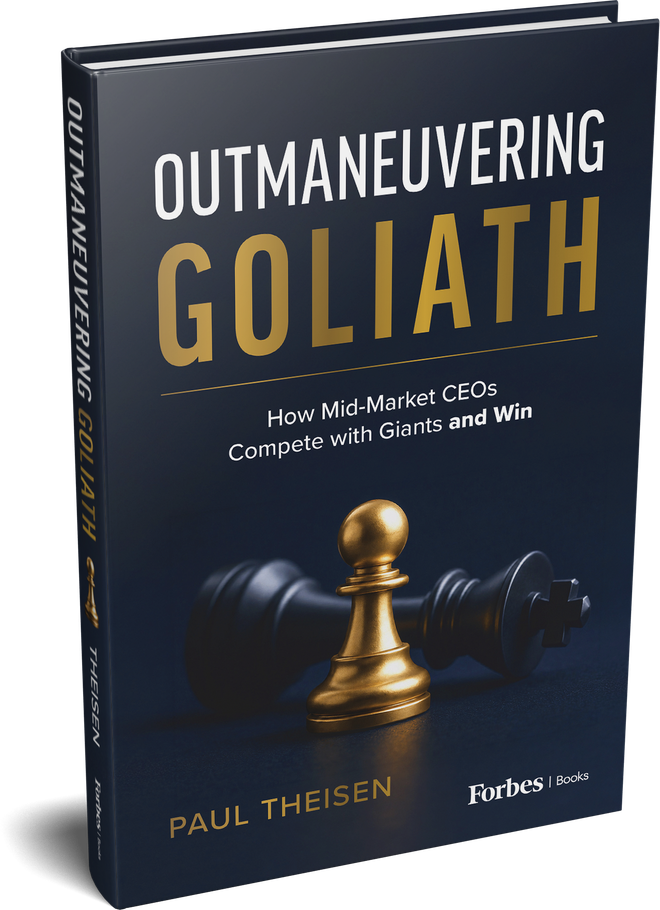










“In his latest project, Outmaneuvering Goliath, Paul Theisen shows us his authentic approach to helping others. Using stories and language that are quick to grasp, Paul’s real passion for serving others shines through. The energy he shares through his writing and insight is a lasting way to continue to share his leadership approach.”
Scott DelaneyFormer VP & GM Tech Data Lifecycle Services; Managing Partner, Tiburon Cloud Partners 
“The business landscape has fundamentally shifted. Private equity consolidation, artificial intelligence disruption, volatile capital markets, and relentless supply chain pressures have created an environment where mid-sized companies face an existential crossroads: adapt or be absorbed.
Paul’s book is the strategic playbook that middle market leaders have been desperately waiting for. Rather than viewing their size as a liability, Paul masterfully reframes it as a competitive superpower, unlocking the agility, speed, and market intelligence that neither startups nor enterprise giants can replicate.
This is not theory. This is a battle-tested roadmap for thriving in one of the most challenging business climates in modern history. Every middle market executive needs to consider these ideas as a way to succeed going forward.”
David MylesFormer PE Operating Partner, Bestige Holdings and 3x CEO; Board Director; Vistage Chair
“I had the opportunity to work closely with Paul and saw firsthand his ability to think strategically, make difficult decisions, and still drive the tactics necessary to get results. Outmaneuvering Goliath reflects the same qualities I saw in Paul as an executive: clarity of thought, sound judgment, persistence, and a practical understanding of how organizations really operate. It is a valuable book for mid-market leaders who understand that you don’t need to be the biggest company to be the better competitor.”
Mike KemperFormer President & CEO, NPL Construction Company; Consultant and Board Director
“Outmaneuvering Goliath contains fresh insights and encouraging inspiration for middle market CEOs! Paul provides convincing arguments and practical strategies to outperform larger competitors with technology reaching its full potential to catalyze growth.”
Paul’s book is the strategic playbook that middle market leaders have been desperately waiting for. Rather than viewing their size as a liability, Paul masterfully reframes it as a competitive superpower, unlocking the agility, speed, and market intelligence that neither startups nor enterprise giants can replicate.
This is not theory. This is a battle-tested roadmap for thriving in one of the most challenging business climates in modern history. Every middle market executive needs to consider these ideas as a way to succeed going forward.”
Mike StanleyChair, C12 Greater Phoenix; Board Director
“Paul Theisen clearly articulates a challenge many growing companies face but struggle to define: organizational complexity outpacing leadership capacity. As a COO who successfully integrated a fractional CIO into our business, I have seen firsthand many of the advantages described in this book. Outmaneuvering Goliath offers practical insights for leaders looking to scale smarter, make better decisions, and unlock the full potential of their organizations.”Paul’s book is the strategic playbook that middle market leaders have been desperately waiting for. Rather than viewing their size as a liability, Paul masterfully reframes it as a competitive superpower, unlocking the agility, speed, and market intelligence that neither startups nor enterprise giants can replicate.
This is not theory. This is a battle-tested roadmap for thriving in one of the most challenging business climates in modern history. Every middle market executive needs to consider these ideas as a way to succeed going forward.”
Alfonso TrujilloChief Operating Officer, MMI Industrial & Steel
“There’s an adage that 'the strong beat the weak, and the smart beat the strong.' Paul provides relatable stories on how mid-market companies can leverage leadership and technology to outmaneuver their goliath competition. This book is a must-read for anyone who wants to understand how to combine the nimbleness of a mid-market company with the leadership talent of a goliath.”
This is not theory. This is a battle-tested roadmap for thriving in one of the most challenging business climates in modern history. Every middle market executive needs to consider these ideas as a way to succeed going forward.”
Eric WalterChief Financial Officer and PE Operating Partner, DMC Global
“A clear perspective on challenges growing companies face but few recognize. Calling out the gap between organizational complexity and leadership capacity is a bedrock challenge faced by management in every organization. Paul makes a compelling case that technology and AI are not substitutes for judgment; rather, they amplify the discipline, clarity, and accountability already present in an organization. His practical framework for aligning leadership, talent, and technology gives middle-market leaders a way to move with greater confidence, agility, and intention. Most importantly, the book reminds me that the real competitive advantage is not having more resources, but knowing how to apply the right judgment at the right time.”
Chad FayPresident, High Country France